Text Box: Rozashi Classes

I currently offer several classes in the Rozashi technique.  To see the details, click on the class title or picture for the class you'd like to see. (NOTE: With silk cost rising rapidly and the Dollar weak against the Yen, kit costs will continue to rise.)

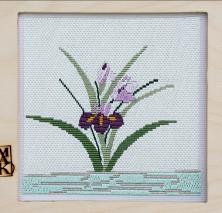
A beautiful Rozashi piece that incorporates the iris and reeds.  Measures approximately 5 1/2" x 5 1/2" A beginner and beyond level piece

Magnolia kobus is the focal point in many Japanese gardens, as well as in art.  Fumiko Ozaki has designed a branch of Japanese magnolia blossoms for our study. She honors us with this design. Finished piece measures approximately 5.5"x 5.5" (17.0 cm x 17.0 cm).

The new favorite of many stitchers, this piece has lots of variety in stitches duplicating the patterns on ribbons.  Measures approximately 3 1/4" x 2" (8.2 cm x 5 cm).  A beginner and beyond level piece.

Baby Iris is a beginning study in the Japanese needlework technique of Rozashi.  The class will teach the very basic stitches and prepare the participants to pursue Rozashi.

All class kits include:

· Frame

· Mounted ro w/ drawing

· All required threads

· Rozashi needle

Complete instructions

 The Noshi is a very strong symbol in Japanese mythology. In reality, Noshi is a bundle of strips of dried abalone. In the Edo period it was used as an offering to the military ruler  during the 9th lunar month. On very important occasions noshi was used as part of the gift wrap. Our noshi is created in the style of a family crest

Bamboo, plum blossom and pine depict three friends in Japan symbolism, and are favorite subjects in Japanese art.  According to Merrily Baird, the three motifs are the symbols of “winter and long life, and the cultured gentleman.”

Autumn’s Pool is a study in traditional Rozashi stitches.  The maple tree is revered in Japan. This piece teaches a wide variety of Rozashi stitches and produces a beautiful result.

Tropical fish is worked in Rozashi.  The fish is tropical shades with accents.  The stitches are the irregular, ichi dan,  Rozashi satin, and line stitch.  All stitches are traditional to Rozashi.  The fish is appliquéd onto a silk fabric and finished with a silver metallic Rozashi thread. 

In Japanese art, patterns within the work are integral to the overall work. Our Patterns’ origins are those found in nature and everyday life.  The wave pattern anchors the piece in the lower section of the design.  Other stylized patterns are tortoise shell, thatch, patterns from fabric weaving and other everyday life patterns. 

Sweet Violet is a small study in the basics of Rozashi.  Rozashi is a Japanese needlepoint/counted technique that dates back to 700 A.D.  The materials in this small study are traditional to Rozashi.  A tightly twisted silk thread is the main silk used.  It is like no other silk twist. 

The Petite Sampler is a study in traditional Japanese Patterns.  Navy blue silk is used to define each section.  The colors are dark navy, dark red, peach and gold, and reminiscent to the colors used in the ancient Imari plates so favored in Japan. 

Cherry Blossoms, in Japanese, Sakura, are the most popular early spring images in Japanese Art. This Rozashi study is worked in the traditional threads designed especially for the ro. The colors are the traditional soft pinks. The threads are all silk, a mix of metallic and silk, and metallic. A beginner and beyond level piece.

Fans are beloved in Japan.  Our fan is filled with geometric patterns and petite patterns that represent the poems to a friend or beloved.  The patterns in this study can be found in everyday items of living such as fabrics, paintings, pottery, woven mats, and ties for obis among other uses.

Flower Cloud with Butterfly

In Flower Cloud with Butterfly the mum is the most revered of flowers in Japan.  The colorful butterfly is a rainbow of colors. The design is beautiful and traditional.

The beautifully elegantly shaped Rozashi piece is a study in muted colors and traditional Rozashi stitches.  It is worked in the stitches of Rozashi on the silk schrim especially created for this technique.  The lovely pale colors of blue and lilac Rozashi silks create the small flowers that make the flower head.  Greens and gold metallic complete the leaves and flower

Three Butterflies is a study in the basics of Rozashi.  The beautiful butterflies are swarming over a plot of tall grass. They are a rainbow of colors ranging from light purples and taupe to buttercup pale yellow.  The threads are silk, brocade - a combination of silks, silver metallic, and a variegated urushi thread that combines pastels with gold and silver.


Desert Flower is a much stylized  floral motif.  It is typical in  Japanese art to simplify an object.  This type of flower was imported from China to Japan. The flower is worked in the pale colors of the desert with the tendrils being a luscious green – symbolizing the hope for the rains to make the desert a green place.